Crawlspaces beneath residences in older Marietta neighborhoods like Whitlock Heights, Forest Hills, and Historic Marietta Square often feature vented brick-and-mortar foundations exposed to red Georgia clay. This…
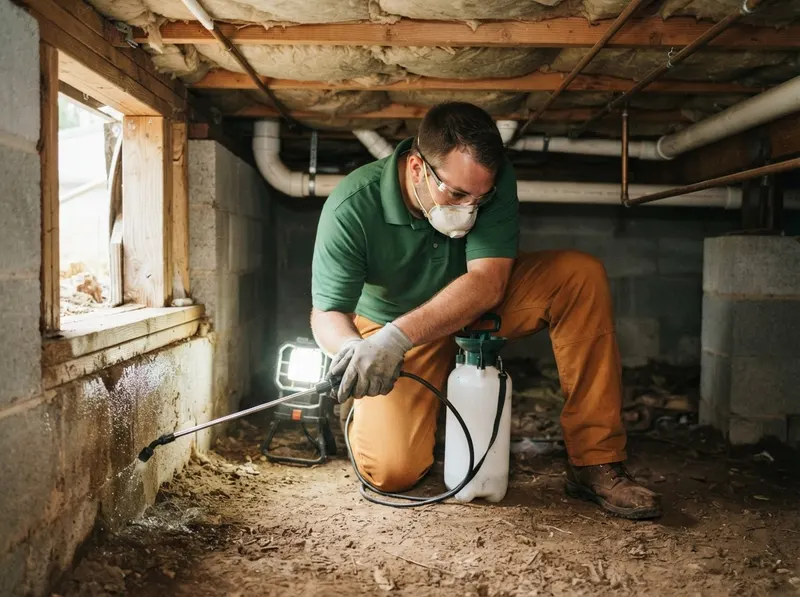
Crawlspaces beneath residences in older Marietta neighborhoods like Whitlock Heights, Forest Hills, and Historic Marietta Square often feature vented brick-and-mortar foundations exposed to red Georgia clay. This high-humidity subfloor environment creates a thermal refuge for smokybrown cockroaches, subterranean termites, and rodent colonies seeking warmth under floor joists. Unlike indiscriminate broadcast spraying, crawlspace pest barrier application targets the precise moisture-to-masonry transitions where pests enter. A technician mechanical-seals foundation sill plates, foundation penetrations, and vents with galvanized 1/4-inch steel mesh, while treating exposed ground timbers with borate-based structural compounds that deter wood-boring insects without releasing airborne irritants into ductwork.
Selecting a perimeter crawlspace barrier application serves properties showing localized signs of subfloor intrusion, such as shredded insulation batting, scratching noises between midnight and 5:00 AM, or musty basement odors. For homes bordering heavily wooded creek areas in Indian Hills, Somerset, and Chimney Springs, standard yard treatments fail because rodents run along foundation walls beneath tree cover. A structural barrier anchors direct defense along foundation footings and support piers. When deciding between a targeted mechanical crawlspace seal and full structural crawlspace encapsulation, homeowners balance immediate pest prevention with total moisture remediation. A targeted barrier resolves rodent pathways and insect nesting within 48 hours at lower capital expense, whereas full multi-mil encapsulation covers lifelong ambient humidity control but requires installing automated crawlspace dehumidifiers.
Every application follows a sequence: first, clearing debris and monitoring entry holes along the rim joist; second, blocking pipe and wiring chaseways using heavy-gauge wire cloth and polyurethane expanding foam; third, laying minimum 10-mil poly sheeting anchored 6 inches up masonry piers; and fourth, applying low-toxicity, pet-conscious residual botanical or microencapsulated barriers along interior masonry borders. Homeowners in Battleview and West Park near Kennesaw Mountain National Battlefield Park benefit from these non-staining formulations, which preserve indoor air quality for crawling infants and house pets while securing foundation timber against moisture-driven pests.
Every job gets a firm, written price after a free on-site visit.
Tell us about your crawlspace pest barrier application job in Marietta and we'll send a clear, written quote, usually the same day.
 Timberline Pest Control